
SIP (Session Initiation Protocol) services refer to a set of communication services based on the SIP protocol, which is used for initiating, maintaining, and terminating real-time communication sessions such as voice calls over the internet.
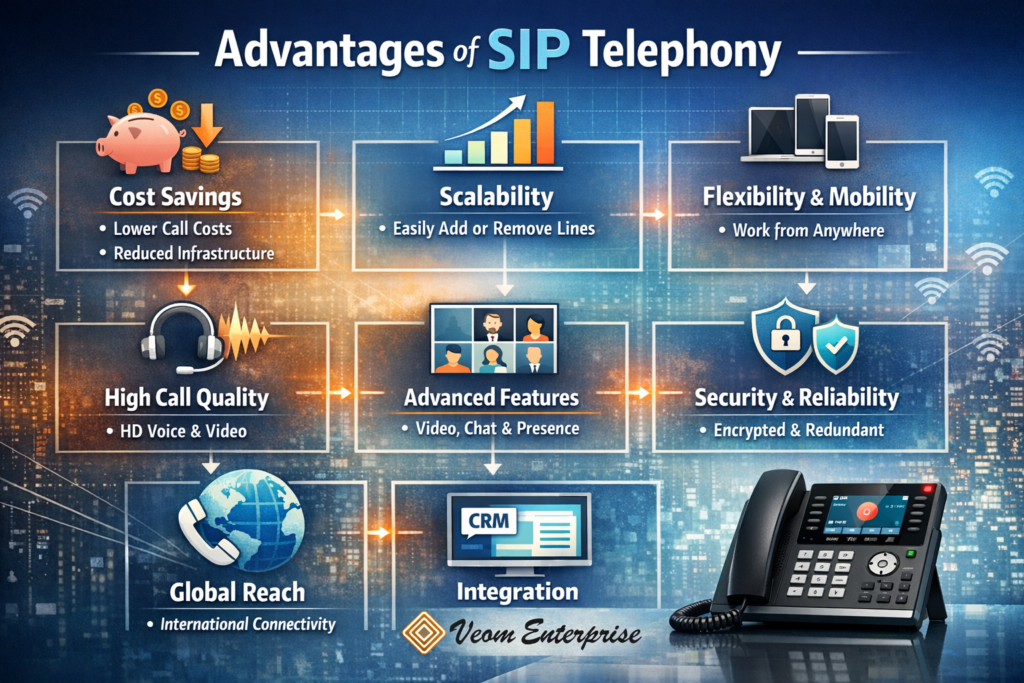
1. Cost Savings
- Lower Call Costs: SIP telephony reduces the cost. Since SIP uses the internet for voice communication, the expenses tied to traditional telephony systems (such as landline or mobile charges) are significantly lower.
- Elimination of Expensive Infrastructure: SIP eliminates the need for expensive hardware and phone lines, as communication takes place over the internet.
2. Scalability
- SIP services are highly scalable, allowing businesses to easily add or remove lines without significant infrastructure changes. New users can be added with minimal cost and effort.
- For small businesses or growing enterprises, SIP systems can expand as needed, providing flexibility to meet changing demands.
3. Flexibility and Mobility
- Remote Work: SIP enables employees to make and receive calls from anywhere, whether they are at home, in the office, or on the go. All that’s required is an internet connection, which makes it an ideal solution for remote work and mobile teams.
- Device Compatibility: SIP can be used with a variety of devices, including smartphones, desktop phones, and computers. Users can also switch devices seamlessly during calls.
4. Improved Call Quality
- SIP telephony typically supports high-definition voice and video calls, offering superior call quality compared to traditional telephone services.
- The technology enables features such as noise reduction and echo cancellation, improving the clarity of communication.
5. Advanced Features– Soft Telephony support
- Video Conferencing: In addition to voice calls, SIP supports video calling and conferencing, allowing users to communicate through multiple channels.
- Instant Messaging: SIP enables integrated text messaging alongside voice and video calls, streamlining communication.
- Presence Information: Users can see the availability status (e.g., online, busy, away) of other users in the network, enhancing communication efficiency.
6. Simplified Communication System Management
- SIP enables central management of communication systems. Businesses can configure and monitor their telephony system through web interfaces, simplifying maintenance and troubleshooting.
- Integration with other communication tools (email, chat, CRM systems) is easy, creating a unified communication platform.
7. Redundancy and Reliability
- SIP can be configured with failover solutions. If one server or network link goes down, calls can be automatically rerouted to another, ensuring business continuity.
- It allows businesses to have multiple backup routes, minimizing service interruptions.
8. Security
- SIP supports encryption protocols (e.g., Secure SIP or TLS) to protect the privacy and security of calls, ensuring that sensitive information is not compromised during transmission.
- SIP can be integrated with firewalls, authentication, and access control systems to add layers of security.
9. Integration with Other Communication Tools
- SIP can be integrated with a variety of business applications like customer relationship management (CRM) software and email allowing a seamless workflow for businesses.
- It also allows integration with external communication networks, enabling businesses to extend their communication system beyond their private infrastructure.
12. Convergence of Communication
- SIP telephony is a powerful tool for modern communication, offering flexibility, cost savings, and a wide range of advanced features. Whether for businesses looking to streamline their communications or individuals seeking more convenient and cost-effective alternatives to traditional phone services, SIP provides a robust solution.
Interested to know more on SIP solutions with Veom Enterprise, just drop your contact details;